
Laurens County Release Date Types
A projected date is a forward-looking sentence estimate. An actual date records a completed departure from a jail or prison. Those dates can differ. South Carolina's public calculator assumes the person earns all available credits, so its result is an earliest-possible scenario. A detainer, lost credit, new conviction, sentence correction, or other event can move the true date later.
A Johnson Detention Center detainee awaiting trial has no fixed sentence-completion date. A bond order can authorize release, but processing and other holds may still prevent immediate departure. Someone serving a short local sentence may have credits calculated under state law. A person sentenced to SCDC has a state computation. Federal sentences are computed by the Bureau of Prisons and are not controlled by Laurens County records.
Find a Laurens County Release Date
Start with the legal and custody facts, not a date calculator. The current Laurens roster shows people reported in LCSO custody but does not display a configured release-date field. SCDC maintains separate current-prisoner and released-inmate tools. Mixing those systems can turn a county transfer into a false claim of community release.
- Identify whether the person is pretrial at Johnson Detention Center, serving a local sentence, in SCDC, or in federal custody.
- For pretrial custody, review the Laurens court case for bond and orders, then ask Booking about current custody. Do not expect a sentence projection.
- For a local sentence, request the judgment, jail credit, and release computation from the court or county custodian.
- For a general South Carolina estimate, use the official SCDC Release Date Calculator and read its disclaimer first.
- For an already sentenced SCDC prisoner, ask SCDC Inmate Records at 803-896-8531 for the case-specific computation.
- After departure, compare the actual date with the SCDC released list or the Johnson Detention Center release record.
The broader Laurens County release-record path shows how to distinguish roster absence, transfer, supervision, and community release.
Note: A court order may authorize release, but the custodian's record shows when processing ended and whether another agency received the person.
Laurens County SCDC Release Estimate
The SCDC calculator disclaimer limits how the public result may be used. It gives general guidance and assumes every possible good-time and work credit. It does not create an official record. It cannot calculate the authoritative date for a person who has already been sentenced. It also excludes Youthful Offender Act cases and does not account for prior or later convictions.
Enter only facts supported by the sentence and applicable legal category. Label the output as an estimate. Do not publish it as a promise from SCDC or Johnson Detention Center. Questions about a sentenced person's actual computation go to SCDC Inmate Records. Once the state prisoner leaves custody, the dedicated SCDC Released Inmate Search supplies the actual release date and exact release type.
The public calculator interface appears in this successful capture from the official SCDC calculator.
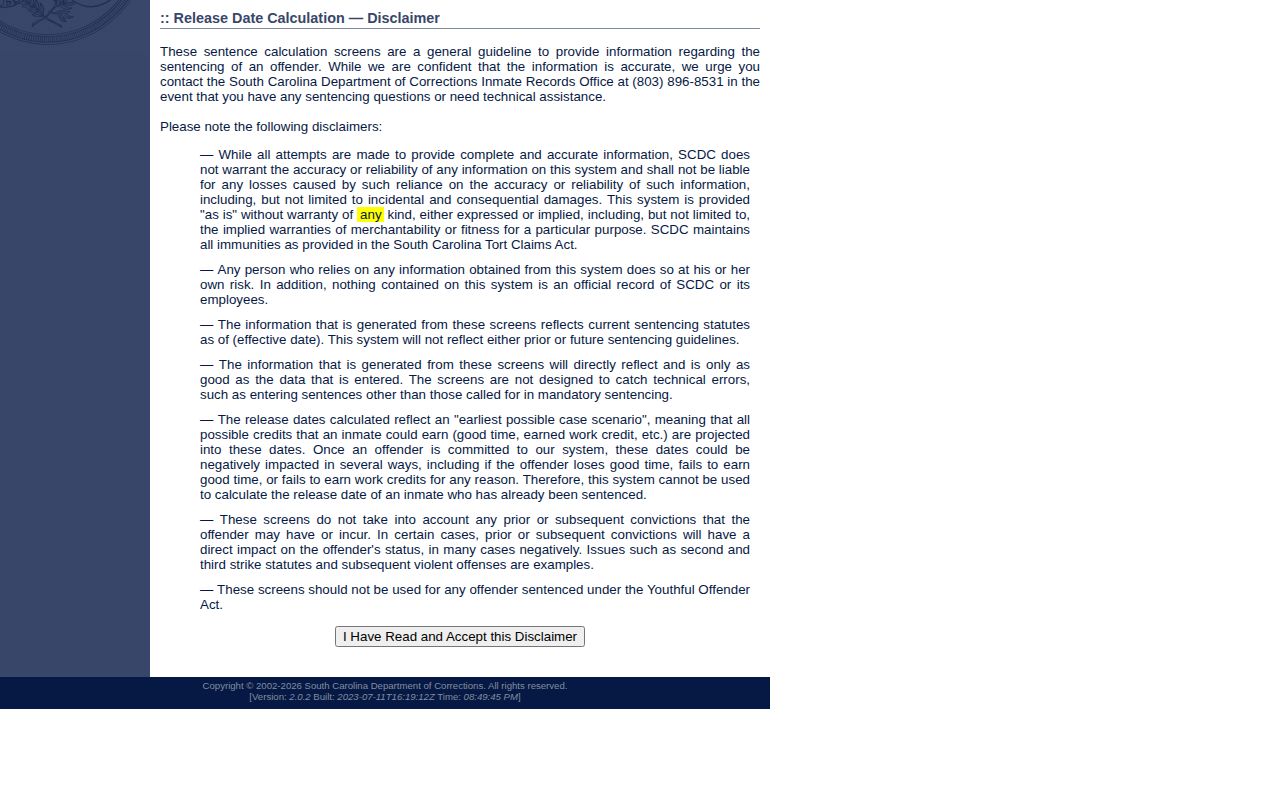
Its inputs produce an earliest-case estimate, while the disclaimer and later custodian record control how that estimate is described.
Laurens County Sentence Computation
South Carolina computation begins with the imposed sentence, qualifying jail credit, and the offense category. Title 24, Chapter 13 of the South Carolina Code contains the governing provisions. Section 24-13-40 generally computes time from sentence imposition and provides qualifying credit for pretrial detention, subject to listed exclusions. Section 24-13-175 directs the use of 365-day years.
Concurrent terms run together to the extent the judgment permits. Consecutive terms run one after another. Suspended portions, prior or later cases, sentencing corrections, and holds may alter the operative date. Court records explain the sentence, but SCDC or the local custodian applies the computation to its custody record. A discrepancy should be resolved through the custodian and, when needed, the sentencing court.
- Jail credit
- Qualifying time spent in detention before sentence that is credited under the governing judgment and statute.
- Concurrent
- Sentences that run at the same time.
- Consecutive
- Sentences that run one after another.
- Detainer
- A request or legal hold from another authority that may affect where the person goes next.
Laurens County Good-Time Credits
Section 24-13-210 distinguishes good-conduct credit. A non-no-parole SCDC inmate can earn 20 days per month. A no-parole inmate can earn three days per month but cannot use those credits to fall below the statutory minimum. Credits may be forfeited. A person serving a local detention-center sentence may receive one day for each two days served under that provision, so the county calculation should not be assumed to match an SCDC term.
Productive-duty and education credit come from Section 24-13-230. For a non-no-parole SCDC term, the award can range from zero to one day for each two days of qualifying work or education, subject to statutory combined limits that include 180 days per year. A no-parole inmate may earn six days per month, capped at 72 days per year, without breaking the minimum term. Local mandatory productive duty can earn zero to one day for each two days.
Credits are earned, not guaranteed. The calculator's full-credit assumption explains why its earliest date may move later. The sentence record and SCDC computation should show which rules apply in a specific case.
Laurens County 85 Percent Rule
Section 24-13-100 defines a no-parole offense by statutory class and maximum punishment. Under Section 24-13-150, a person convicted of such an offense may not receive early release, discharge, or community supervision until serving at least 85 percent of the actual imprisonment imposed. The suspended part is excluded from that base. Work, education, and good-conduct credits cannot reduce the term below the floor.
The rule does not apply to every Laurens County sentence. Separate restrictions also exist for murder and other offenses. Determine the offense classification and judgment before applying the percentage. A rough calculation made from a charge name can be wrong, especially when pleas, amended counts, concurrent terms, or sentence corrections are involved.
Laurens County Jail Release Credits
Local detention and state-prison credits must remain separate. Section 24-13-210 allows a person serving a local detention-center sentence to receive one day for every two days served under the statutory rule. Section 24-13-230 also provides a local mandatory productive-duty credit ranging from zero to one day for each two days of qualifying work. The custodian must apply the rule to the actual sentence and institutional record.
Those provisions do not create a release date for a pretrial detainee. Before judgment, bond, court action, charges, and holds control whether the person can leave. After a local sentence begins, the judgment, credited pretrial time, earned local credit, and any forfeiture affect the estimate. Johnson Detention Center or the sentencing court should resolve the case-specific facts. Do not enter a local jail term into the SCDC calculator and label the result as a county release date.
A transfer to SCDC starts a different computation path. The county transfer record identifies when Laurens custody ended, while SCDC determines the state sentence and later records its own release.
Why Laurens County Dates Change
A valid estimate can change after it is first calculated. The source of the change determines which record can explain it. Ask for the underlying computation rather than treating each revised date as an error.
| Factor | Possible effect | Record to check |
|---|---|---|
| Credit not earned or forfeited | Moves the estimate later | SCDC or jail computation |
| Jail-credit review | Adds or removes credited days | Judgment and custodian calculation |
| Concurrent or consecutive correction | Changes how terms combine | Court order and sentence record |
| Detainer or hold | May change destination even when one custody term ends | Custodian and receiving agency record |
| New conviction or amended sentence | Can add time or alter eligibility | Court docket and computation |
| Parole decision | May authorize conditional release but does not set door-release time alone | Board result and SCDC record |
Discipline can cause credit loss. A later award cannot break an 85-percent floor. A transfer under a detainer ends one agency's custody but may begin another's. These facts explain why the actual release record remains essential.
Note: An SCDC release type such as probation, community supervision, or supervised reentry means prison custody ended while legal supervision continued.
Confirm Laurens County Actual Release
For Johnson Detention Center, use the official jail information and ask Booking at 864-683-4783 for a current operational check. Use the LCSO public-information contact for durable proof. Request the release date and time, release reason, authority, destination or receiving agency, and hold disposition. A roster disappearance alone is inconclusive because the person could have transferred to SCDC, another jail, USMS, or ICE.
For a county sentence, the Laurens Public Index can orient the search to the judgment and later court actions. It is not the physical-release log, so compare the order with the custodian's final entry.
For SCDC, use the released-inmate list after departure and record the exact release type. A state row can say released, probation, community supervision, or supervised reentry. For a pending status alert, the Laurens County VINELink inmate search may add corroboration, but its contributor status is not a certified sentence computation.
Federal calculations follow BOP rules and records. The BOP sentence-computation resource is the correct federal starting point. A federal projected date does not answer a Johnson Detention Center or SCDC release question.
Record the date on which each source was checked. A live roster, a court docket, a calculator result, and a released-inmate row may update on different schedules. If two sources conflict, give priority to the custodian that computed the sentence or created the final release entry, then ask for correction or clarification. Keep the original estimate only as history. It should not replace a later official computation. This method also prevents a transfer date, parole eligibility date, board hearing date, or supervision start date from being mislabeled as the day the person actually left custody.